How to String a Fishing Pole Effectively – 8 Influential Guides
Contents
- Let’s Learn How to String a Fishing Pole by Starting from Very Beginning!
- 1. Understand the Types of Fishing Poles.
- 2. Types of Reels Are Also Important to Consider.
- 3. Types of Fishing Lines Come Next.
- 4. Start the Process by Assembling Your Rod.
- Watch This!
- 5. Time to Put the Reel on Your Rod.
- 6. Next, Fix the Line to Reel.
- 7. Line Needs to Come from Right Direction.
- 8. Rolling the Line.
- 9. Finally, Attach the Hook with Line.
- Some Mistakes You Should Avoid.
- 1. Wrong Knots Can Bring Miseries.
- 2. Line Overfilling.
- 3.The Tension Needs to Be Sufficient.
- 4. Don’t Miss an Eyelet.
- Watch This!
- Conclusion
- Sources
if you are someone who possesses the quality of having a great amount of patience, you’ll love fishing . It’s one rewarding activity that some people find boring just because there’s a lot to do with having endurance.
A new fishing enthusiast has a lot to learn and know about . However, one common concept that the newcomers feel a bit perplexed on is about stringing a fishing pole. Without a proper sense of how to string a fishing pole, you can’t expect to catch a lot of fishes. And that’s why it’s high time as a beginner in this fishing territory, you give yourself some time in adapting the skill of proper stringing.
Let’s Learn How to String a Fishing Pole by Starting from Very Beginning!
To a few, how to thread a fishing rod may sound too challenging as a task. And so, it’ll be better for the newbies to start from basics. Stringing a fishing pole needs you to have a good amount of ideas regarding different types of rods, reels, and lines available. Because these parts are also involved in the whole stringing game. Let’s get on it . First we see them in list and then we go for detail
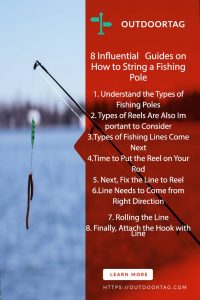
1. Understand the Types of Fishing Poles.
To understand all those so-called fishing pole setup beginners friendly instructions, you also need some basic idea about the rod types that can be involved. Depending on what location, fish species you are aiming for and the task, there will be a need for a specific kind of pole . And that decision will only be right when you have a good sense of the wide range of rods available. Here’re some short notes on that.
The first type is fly rods. These come in many lengths and line weights. Light fly rods suit small trout and panfish, while heavier ones handle big fish such as salmon. Instead of a lure's weight, a fly rod casts the weight of a thick, heavy fly line, which carries a nearly weightless fly. The fish line needs to be heavy with this type.
The next category is about casting rods. For open water or running stream fishing, casting rods work wonderfully. You can position the bait on hook more precisely. And so, the luring is no hassle with this type. Baitcasting and spin casting are two options of this category. The baitcasting rod comes with more than a few tiny eyes including one located near reel. Spin-casting reels are often mounted on casting-style rods too, with the reel sitting on top of the handle.
The final type is spinning rods, which some confuse with casting rods. A spinning reel hangs below the rod, and the guide nearest the reel is large. That big first guide gathers the loops of line coming off the reel and cuts friction when you cast.
2. Types of Reels Are Also Important to Consider.
Someone who is trying to learn about stringing a fishing rod, there’s a need to understand about reel types that they are going to use. Because depending on the type of reel one is planning to use, there will be some different points to consider. Basically, there are three types of reels you should be aware of.
The first type is spinning reels. These are known for providing better accuracy as well as easier usability. It’s the more popular type as well because of simple functioning and easy to learn design. When you use a spinning reel, go for lightweight lines to get a better result.
Next is the trickier type called baitcasting reel. It comes with a spool that keeps spinning on every cast you make. The reel will be a fantastic type to get accuracy for someone who has a better experience with fishing. Usually, first-timers find this type less suitable for learning.
And finally, the spin-cast reels. This type of reel comes with a closed face. And that’s because its components are all enclosed within a case that is cone-like in shape. A hole is present with it that allows the line to go out. The reel is easier to learn and use. However, there’s less chance of accuracy with it. Also, it’s not the best compared to other types for offering much distance.
3. Types of Fishing Lines Come Next.
What type of fishing line you are using, is also an important factor when learning how to string a pole. Depending on the conditions, rod type, and fishing goals, there will be a need for a certain line.
The first type of line is braided line, made of multiple fibers woven together. Anglers braided lines from natural fibers long before modern materials. Today's braids use synthetic fibers that are very strong and thin for their strength, with almost no stretch. Braid is easy for fish to see in clear water, so many anglers add a mono or fluorocarbon leader.
The next type is preferred more by learners since it comes with a fantastic holding ability. It’s the monofilament fishing lines. This type can provide amazing results by not slipping within the knot. The less visible to fish materials are used to create monofilament lines. So that a trap for catching fishes is easy to build. The stretching ability of this line is also excellent. It also comes with memory to stay on rounded or curly shape for a pretty long time.
And finally let’s talk about the relatively new type, fluorocarbon lines. Berkley notes that fluorocarbon is nearly invisible underwater, sinks faster than mono and resists abrasion better. It is also stiffer and has more memory than mono, which makes it harder to manage. This type works better for experienced anglers, often on baitcasting reels, and newcomers usually start with mono.
4. Start the Process by Assembling Your Rod.
Watch This!
5. Time to Put the Reel on Your Rod.
Now you will concentrate on putting the reel over your rod. Just bring the reel out of the package and observe it. Look at the foot part specifically for figuring out which section should connect with a rod. There should be a reel seat on your rod. Have a good look at it as well and understand the locking mechanism.
There can be different sorts of mechanisms used here. It can be a sliding-ring, down-locking, or up-locking type. No matter what locking mechanism you end up with, there’s nothing to worry about. These are pretty easy to get a secure lock from. Attach the reel so its line guide or spool points toward the rod tip. A spinning reel hangs below the rod, while baitcasting and spin-cast reels sit on top.
6. Next, Fix the Line to Reel.
From the spool, you should take loose end of line first. Then simply drag the end through guides or rings of your rod. Make sure to let it go through all of the guides (or rings). You need to begin from the guide that is located right on your rod’s tip part. Then follow its next placed one. Keep on passing in the same manner. And then you should complete the passing with guide located near to reel.
If you are using the most popular spinning reel type that comes with a metallic D shape bail around, then let it stay in an open position. The type that involves close face structure with front cone cover, you need to get rid of cone here first. Use the push button if provided or simply unscrew it. The cone should come with a hole where you need to pass line through.
Now you need to tie the line to the reel's spool. The standard knot for this is the arbor knot.
For this, wrap the tag end around the spool, tie an overhand knot in the tag end, then tie another overhand knot with the tag around the main line. Wet the knot and pull the main line so it slides down tight against the spool, with the first knot snug against the second. Then close the bail on a spinning reel before you start winding.
7. Line Needs to Come from Right Direction.
Now you need to check that the line comes off the filler spool in the same direction your reel winds it. For most spinning reels, lay the filler spool flat on the floor so the line comes off in a counterclockwise direction. After a few turns, put a little slack in the line; if it twists and curls on itself, the direction is wrong.
If that happens, you need to flip the filler spool over. This will make line come the same as your reel spinning’s direction. It’s important to check the line direction to ignore any twists issue later.
8. Rolling the Line.
Now you need to gradually start turning the reel’s handle, keeping light tension on the line with your fingers. A typical reel takes far more than a few dozen turns to fill, so keep going. It’s best to avoid filling the reel to its maximum capacity.
Stop when the line is about 1/8 inch from the outside edge of the spool. Overfilling makes line jump off the spool in loose coils. The point that is beyond your rod’s tip, make a cut on your line right here. There should be an extra 2 or 3 feet of line dangling from tip to play it safe. In case of using a front cone reel, you should put it back and ensure it’s not catching with the line.
9. Finally, Attach the Hook with Line.
Beyond the rod tip, you need to attach the hook to the line’s open end. The improved clinch knot is a strong, easy choice. Run about 6 inches of line through the hook’s eye and fold it back.
Wrap the tag end around the main line about five times. Pass the tag end through the small loop next to the eye, then back through the big loop you just formed. Wet the knot, pull it snug against the eye, and trim the tag about 1/4 inch from the knot.
Some Mistakes You Should Avoid.
There are a few mistakes that people tend to make a lot when stringing a fishing pole. Let’s break down the most common ones below to fulfill your learning session:
1. Wrong Knots Can Bring Miseries.
One of the critical mistakes you can do is tying the wrong knot. You need to use a knot that will be able to withstand the tug created by your catch on a line. Use proven knots such as the arbor knot for the spool and the improved clinch for hooks, and tie them carefully.
2. Line Overfilling.
The line and spool end need to have a specific room in between to work better. Overstepping here can result into a poor performance of reel later on. A spool that is overfilled by string will feel very hard to keep the line tightly against itself. In the worst case, you may experience tangling as well. And that’s huge bad news for your fishing plans for the following day.
3.The Tension Needs to Be Sufficient.
Line wound on loosely is an open invitation to tangles. When a fish pulls, tight line can dig into the loose wraps below it. And so, it’s very important to keep light tension on the line as you fill the spool.
4. Don’t Miss an Eyelet.
Since there are micro guides, you may experience coming across a frame that has small gaps right between the actual eyelet and frame. And in this case, usually, the eyelet is very minuscule.
As a result, there’s a chance of running the lines between this hole between frame and eyelet. However, it was supposed to go through the eyelets. This can lead to a very serious problem as sharp edges of frames are extremely dangerous for the lines. So, pay extra attention to gears that come with such confusing combinations.
Also Read: How to Spool a Baitcaster with Different Types of Lines?
Watch This!
Conclusion
For the best catches, you must pay attention to learning how to string a fishing pole. The matter itself comprises other points to understand as well. And hopefully, this guide made your all confusion go away.
Also, you should pay attention to buying a proper reel, rod, and line for this process. The certain types that were mentioned today are available in various models from so many brands. You need to be aware of what a good reel, rod, or line looks like when purchasing any one of these.
Even one poor-quality gear among these will be a problem to deal with no matter how skilled you are with stringing the pole. So, make sure you don’t sleep on that fact and carelessly push it for regretting later.
Sources
- An Introduction to Fishing, Missouri Department of Conservation
- Benefits of Fluorocarbon Lines for Clear Water, Berkley Fishing