What Does the Inside of a Golf Ball Look Like? [Layers & Core]
Contents
- What Does the Inside of a Golf Ball Look Like?
- Rubber is Usually the Main Core Material Inside a Golf Ball.
- One-Piece Ball Inside Consists Only One Material.
- Two-Piece Balls Uses Solid Core with Durable Cover.
- Three-Piece Balls Uses More Wrapping.
- Four-Piece Balls Meant for Pros Come with Feel Creating Additional Layer.
- Five-Piece Balls Come With 3 Thin Layers Inside.
- Six-Piece Balls Used Soft Core with Layers Firming Gradually.
- The Old Golf Balls Inside Used To Have Liquid Filled Core.
- However, did golf balls used to have rubber bands inside?
- Wrap Up
- Sources
There are several matters that need some serious discussion I believe. Being aware of legal matters related to golf balls, such as the liability of a golf ball damage is important. Before making a purchase knowing the manufacturing matters, even if its well-known brand, such as titleist place of manufacturing balls, is important.
But matters such as going deeper into the golf ball, the main hero of this entire game, finding its inner and outer outlook, is also equally significant.
Knowing how a ball is built can save you from buying several kinds before you find the right feel for your game. Something, that from a simple discussion on what does the inside of a golf ball look like could quite easily sort.
What Does the Inside of a Golf Ball Look Like?
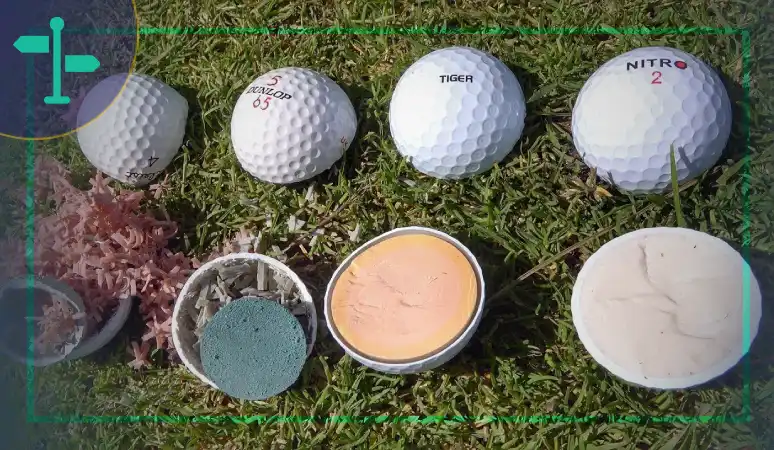
A large rubber core, often wrapped in one or more thin layers, all inside a thin plastic cover: that's how it looks. Depending on the brand as well as the provided quality, the interior, however, can vary. You should be able to find the information in the box. As the number of pieces used for making the ball should be mentioned there.
Now that you know shortly, what does it look like inside of a golf ball, let’s go a bit deeper? By exploring the various sorts of interior structures that golf ball has. I hope it helps.
Rubber is Usually the Main Core Material Inside a Golf Ball.
Anyone wondering, what is the material inside a golf ball, shall find that rubber is usually the one. It basically does a decent job at playing the core role of a golf ball interior. The outside cover is usually one of two plastics. Many balls use an ionomer, a thermoplastic resin best known by the brand name Surlyn, while most tour-level balls use urethane.
For Your Information: Surlyn covers are tough and cut-resistant, which is why they are common on distance and range balls. Urethane covers are softer and add greenside spin.
In a typical case, the inside core is made from synthetic rubber, usually polybutadiene. Manufacturers add other ingredients to tune the core, such as zinc acrylate to set firmness, and some balls have used small amounts of metals like tungsten or titanium in the core or mantle layers to adjust weight.
The layers inside the golf ball basically helps in adding aspects such as:
- The overall feel of the ball.
- It’s speed.
- And distance.
On a friendly note, keep in mind there are certain weather or condition factors that make golf balls behave a certain way. If during the colder days, your golf ball is not going a certain distance, as it used to before, this is not a manufacturing or quality fault.
Cold air is denser, and a cold ball is less lively, so shots come up shorter. Carry drops by about 2 yards for every 10 degrees Fahrenheit colder. You can find more on how far does a golf ball travel in cold weather if in doubt.
One-Piece Ball Inside Consists Only One Material.
The inside of this golf ball is one solid piece of material, with the dimples molded right into it. The difference from other golf ball types is that a one-piece ball has no separate core underneath an outside cover.
Anyone who is just starting can buy these, as the pricing is very cheap. In fact, it’s the cheapest one you’ll be able to get. Often first-time golfers will carry a lot of these. Also, the driving ranges have these plenty. So that one can get and restock as necessary.
Two-Piece Balls Uses Solid Core with Durable Cover.
Then we have the two-piece type. And the inside of this golf ball looks like two segments. One uses a tough rubber core. And the other segment is all about a robust outer layer, often made of an ionomer resin, also known as thermoplastic.
The rubber is a hard block at first. And then through proper heating as well as pressing, it turns into the shape of a sphere.
Three-Piece Balls Uses More Wrapping.
If you get a 3-piece golf ball, then the inside should look like a blend of more than one wrappings. Yes, there’s a wrapping layer of rubber for the core part with this type of golf ball. And then the outer cover goes over for the final covering.
Four-Piece Balls Meant for Pros Come with Feel Creating Additional Layer.
This is the type that basically focuses on the overall feel of the golf ball. Usually meant and targeted for professional golf players. The four-piece golf ball inside looks like a well-planned layered structure to meet that feel purpose.
So, you should find an additional thin mantle layer between the core and the cover. Four-piece balls usually cost more, and whether the extra layer is worth it depends on your swing speed and how much you value greenside spin.
Five-Piece Balls Come With 3 Thin Layers Inside.
Then there are the 5-piece balls that some brands make. The inside of this type has a rubber core wrapped in three thin layers, and then the thin plastic cover goes over the top.
Six-Piece Balls Used Soft Core with Layers Firming Gradually.
Six-piece balls are rare. The usual design is a soft core with layers that get gradually firmer toward the outside, finished with a soft outer cover, for six pieces in total.
The Old Golf Balls Inside Used To Have Liquid Filled Core.
I'm sure with this discussion, a few would also be curious about what was inside old golf balls that we don't use these days. Early golfers in Scotland played the featherie, a leather ball stuffed with feathers.
By the mid-1800s, the featherie gave way to the gutta percha ball, or guttie, made from hardened tree sap. Titleist's history notes that featherie maker Allan Robertson split with his apprentice Tom Morris in 1849 over Morris's use of the guttie.
However, did golf balls used to have rubber bands inside?
Yes. Around 1900, the Haskell ball introduced a core wrapped in rubber thread, and it pushed the gutta percha off the scene. For decades, wound balls had a solid or liquid-filled center, a layer of stretched rubber thread, and a thin cover, often made of balata.
Tour pros still mostly played soft, wound, liquid-center balls until solid-core balls took over around 2000. Two-piece distance balls with Surlyn covers arrived in the 1960s.
Wrap Up
And that was a short subtle guide on what does the inside of a golf ball look like. I hope it helps! The golf ball has changed a lot over time, from feathers to tree sap to wound rubber to today's multi-layer solid cores. Still, the basic idea is simple: a core, maybe a few layers, and a cover.
Bye For Now, See You Soon on Another Golf Gossip!